The Man-Making Blog is a practical and inspirational resource
for people interested in supporting our young males
on their journey to manhood.

April 16, 2012

Mentoring for Boys Driving Fast

In the Man-Making book, I profile a lot of men who turn their personal interests into opportunities for connecting with young guys. This provides a chance for shared interests, training in important life skills, hang time with a man or men, and for the development of a male ally. In a world experiencing an epidemic of, what I term, under-male-nourished-boys, this approach to guiding boys toward a responsible manhood is full of wins for all the males involved. Sometimes it even saves lives.

Jay Gubrud is a friend of mine, and a man who loves driving BMW automobiles. He is a member of the BMW Car Club of Minnesota, a group that has a focus on safe and skillful driving. Through the club, Jay learned the National Highway Traffic Administration statistics say motor vehicle crashes are the leading cause of death among teenagers in the United States. In addition, the U.S. Center for Disease Control and Prevention reports crash risk for drivers sixteen and seventeen years old is three times as great as it is for a nineteen and twenty-year-olds. In every age category, the car crash and death statistics are worse for boys than girls. Those numbers got Jay’s attention and he decided to do something.
In every age category,
the car crash and death statistics
are worse for boys than girls.
Like most teens, Jay had developed an early love of driving fast. He said he wished he’d had a high-performance driving program available to him in adolescence, when his love of driving was blooming. In Jay’s words, "My dad had no interest in driving or performance driving so I had to learn from the school of hard knocks. If there would have been someone steering me toward safe driving at that point in my life, I’d have had a lot fewer problems." Just like Jay, most teens find out the limitations of their driving skills on public roads, surrounded by other vehicles, in dangerous real-world conditions, and often with the police involved. He saw a big need to help teenagers become more skillful drivers.

As a direct result of his passion, Jay partnered with the Minnesota Chapter of the BMW Car Club of America to create the Safe Teen Driving Program. Initially, the program put fourteen Minneapolis and St. Paul area teens in the capable hands of instructors from the BMW Club. These people led the students through classroom and on-road training. Instead of taking risks on the street, the kids were able to develop their skills and discover the limits of their vehicles on a safe and custom-made track. Since that first event, hundreds of Minnesota teens have successfully completed this program. While all teens, regardless of gender, need to learn how to become the best possible drivers, young male drivers, with their tendencies for testing their limits and risk-taking in general, stand to gain the most from this kind of training.

Because of his passion for driving, Jay not only helped to create a solid mentoring program for kids, in the process, he very likely prevented serious injury or death for a teenage boy or girl. His story gets even better, however. The BMW Car Club of America used much of the Safe Teen Driving Program in the development of a national program now called Street Survival.

To learn what causes teenage drivers to be such risky drivers, check out this list of primary risk factors. Also, consider how an interest, hobby, or passion of yours might touch the lives of a few kids in your community. You just never know where it might take you.


LIKE: If you enjoy this blog, please visit the Man-Making Facebook page and click the "Like" button.

TWEET: Send this post along to your friends or follow me on Twitter!

SUBSCRIBE: If you're not yet a subscriber to the Man-Making Blog, and you'd like to receive these posts by email 3-4 times a month, go to this link for a free subscription.

CONTACT: Send Earl a message.

April 8, 2012

Men, Boys, and the Wilderness

Four years ago, myself and a group of men started the Desert Men's Council in Tucson, AZ. It's been a fun and challenging adventure that has connected me to really good men, a pack of adolescent males, and occasionally, offered an outing in the desert wilderness or mountains near Tucson. I especially like going camping in the outback with a tribe of males.

I didn't have a father or other men in my life who took me camping. There was one outing when I was a Cub Scout that is still alive in my memory. We only went as far as a town park on the edge of the city where you could still hear traffic. But as a first timer, playing with other guys in the woods, grilling a hot dog outside, sitting around a fire under the stars, and sleeping in a smelly old army tent, all bordered on magical. I can still smell that old tent canvas. I was allowed to sharpen a stick with a real buck knife, and I learned how to start a campfire, put up a tent, and laugh when someone farted at the fire. All those memories come rushing back and the potency of that experience comes back to me every time I go into the wilderness with men and young males.

This last weekend, the men and young guys of the Desert Men's Council held their annual Council Rocks Campout (photos at this link). There were the normal pre-departure challenges to arrange transportation for our food, water, all the campers and their gear. It was sweet to watch the mom's hanging around and seeming to not want to let go of their sons. Finally, after counting off around the circle, a pack of twenty-four males, ages ten to sixty-eight, and a few dogs, loaded into cars and drove over pavement, dirt, and then finally a 4-wheel drive road to get to our campsite in the Dragoon Mountains near Tombstone, AZ.

It was a perfect young guy location. Not a house in sight, in the foothills of the mountains, huge boulders to climb on, and wall paintings and petroglyphs that pre-date the Apache Indians who used the place as a meeting ground.

On arrival we set up a first class camp by dividing into teams. Fire team, kitchen team, and even a team for digging the latrine! With camp prepared, we gathered in a circle to make sure everyone was accounted for (again counting off). We discussed how we were going to approach the challenging afternoon hike, covering the critical importance of hydration in the desert, what to do if we encountered a mountain lion (unlikely), snakes (very possible), and how to travel as a band of brothers, making sure everyone was OK, and that we'd arrive back together safely.

Before heading out we made sure water bottles were filled and then, just before departure, we all gathered around the latrine. It was a first class setup, with a long trench, privacy tarp, pile of dirt and shovel, a great view, and even a bag for used TP to honor our "no trace" intentions. The idea of using the latrine at all was a major shock for the city kids with us. Until that moment, the notion really hadn't crossed their minds. There was some basic training, lots of questions, and wary glances as they considered the possibility of this new experience. I'm sure that for more than one of them, that was the moment they decided they could "hold it" for two days.

I always like seeing a line of men and boys waling on a trail on the way to face a challenge. It's an ancient scene wired into the male DNA and somehow just feels right. As you can see in the photos, it was a challenging hike of about 3 hours in temps that approached 90 degrees. There was rough rock, mini-canyons to negotiate, and plenty of prickly desert plants to get the attention of those who went astray. The tired tribe returned to camp with a rock and cactus bites, great memories, some awesome shots for their Facebook pages, and serious bragging rights.

The fire team started the dinner fire, and the kitchen team assembled the meal. Finally, good food was shared, and the campfire conversations started. Jokes were made, stories from the hike were told, people were honored, and serious topics about male lives were also unfolded. In the process, new friends were made and our male community grew tighter. Tired bodies hit the sleeping bags that night. Most slept out under the stars with such deep quiet you could, at times, hear your heartbeat in your ears.

Dawn, 9 AM for most of the young guys, began an easy move into the day. A breakfast fire and the smell of food being prepared got even the sleepiest dudes out of their bags. Breakfast, and then a morning circle around the fire, gave each male time to check in with what they were feeling, what they liked the best, and what lesson they learned on the experience they would take back to their lives at home. It was a gentle time, where everyone had a chance to be seen, heard, and honored.

I know this is a long story. But if you got this far, it's because there is something in the story that speaks to you. Speaks to a part of you that knows this story, or maybe doesn't and possibly hungers for this experience still. You can believe the men who put on the event are just like you. We all had vastly different skill sets, none of us could have done it on our own, but together, we figured out the details and filled in the blanks to make it all happen. You could too.

If you and some of you male friends were to gather and begin to remember the camping you used to do, or wanted to do, remember leaving the women and children to head out in a pack, the time spent around the fires, the beauty of the night skies, and the "guy conversations" that always occur, you might just stir up enough interest to bring those gifts to some young males in your world. It really doesn't have to be far, elegant (think hot dogs), or in any way perfect. But you can be sure that if you have some young guys along, it just might be life-changing memorable for them. And it will be very good for you're masculine spirit too.


LIKE: If you enjoy this blog, please visit the Man-Making Facebook page and click the "Like" button.

TWEET: Send this post along to your friends or follow me on Twitter!

SUBSCRIBE: If you're not yet a subscriber to the Man-Making Blog, and you'd like to receive these posts by email 3-4 times a month, go to this link for a free subscription.

CONTACT: Send Earl a message.

March 27, 2012

Males and Relationship Violence

About a month ago, my niece was killed by her husband in a murder-suicide. Yes, my family and I are still in shock and working through it. This post is a gesture dedicated to this tragic couple. It's offered with the hope we can all learn something about what went wrong. It's also offered with the hope more people will learn about the issues and then teach young males about abusive and controlling relationships. The quote by Fredrick Douglass, It is easier to build strong children than to repair broken men, was never more true than with this issue.

The very short story is my niece was full of life, creative, attractive, and engaged in the world. Her husband was unemployed, overweight, friendless, isolated, and depressed. In truth, he was a lost man-boy who was leaking self-esteem at a breathtaking rate. Toward the end, the only thing he had going for him was the control he had over his vibrant but vulnerable wife.

We kind of got the feeling that things between them were out of sorts. On the times in the last few years we were able to get together, their behavior was odd. He was dressed inappropriately, was sarcastic and demeaning towards our niece. In front of us all, he would speak badly of her, her parents, and many of the rest of the family. She would occasionally bite back, but was pretty quickly shut down. It was increasingly uncomfortable to be with them, but they put on a happy face, and we couldn't tell how tragically deep the problem was.

At our last meeting with them, he announced for health reasons, it was necessary for her to give up coaching her BMX racing team. This was way off because it had been her joy and passion for many years. We mentioned all the kids who would miss her involvement, but didn't say anything about her decision. He also said that because of the stress she was under, it was necessary for him to step in and manage her finances. She seemed uncomfortable with the idea, but didn't challenge him, and was apparently willing to let it all go. From that time on, it got harder to reach her by phone, and we realized he would often, and increasingly, answer her emails. I think the family rationalized all couples have challenging times, and didn't act to intervene. We were prepared to hear about tough times, but we never thought the family would get THAT call from the police.

Since their passing, we've all learned so much of what we were experiencing with them were common symptoms of an abusive and controlling relationship. As is the case in deep and wet grief, everyone in their circle of family and friends is sharing a small mountain of woulda, coulda, shoulda's. Had we only known what we know now, they both might still be alive. So let me share with you just a little of what you, young males, and everyone else really should know:
  • Relationship violence can be defined as a pattern of behavior used to gain or maintain power and control over an intimate partner.
  •  
  • Abuse in relationship can be physical, sexual, emotional, economic or psychological actions or threats of actions that frighten, intimidate, terrorize, manipulate, hurt, humiliate, blame, injure or wound someone.
  •  
  • These forms of violence can happen to anyone, at any age, of any race, sexual orientation, religion or gender. It can happen to people of all socioeconomic backgrounds and education levels, and couples who are married, living together, or those who are dating.
  •  
  • Teens are seriously at risk for dating violence. Research shows that physical or sexual abuse is a part of 1 in 3 high school relationships (http://goo.gl/0JGWD).
  •  
  • While there is no question some men are abused by their intimate partners, battering and other forms of relationship abuse is largely a male on female issue. According to the U.S. Department of Justice, 95 percent of the victims of domestic violence are women. The National Crime Victimization Survey consistently finds that no matter who initiates the violence, women are 7 to 10 times more likely to be injured than are men. This is why our young males need to learn about both destructive and healthy relationship dynamics early on.
  •  
  • There is a predictable and addictive cycle of abuse in "power and control" relationships that revolves around anticipating violence; coping with actual acts of violence; or recovering from the violence. Once set in motion, the cycle can usually only be broken with awareness and professional help.
  •  
  • This PDF describes a 2002 study of females killed with a firearm. Almost two-thirds were killed by their intimate partners.
  •  
  • If a friend, date or intimate partner has a history of behaving in the following ways, it may indicate you are in, or headed for an abusive relationship:
Calls you names, insults you, or continually criticizes you.
Does not trust you and acts jealous or possessive.
Tries to isolate you from family or friends.
Monitors where you go, who you call, and who you spend time with.
Does not want you to work.
Controls finances or refuses to share money.
Punishes you by withholding affection.
Expects you to ask permission.
Threatens to hurt you, the children, your family or your pets.
Humiliates you in any way. 

I guess what's really important for me to say is if you or someone you know is caught up in a relationship with these dynamics, PLEASE do something. At the minimum, check out your feelings with a caring "advocate" who will answer the phone at the National Domestic Violence Hotline: 800.799.SAFE (7233). They are available 24/7, and will talk with any person affected by relationship violence, including abuser, victim, friends, family, co-workers, classmates, etc., regardless of your age, sexual orientation, or even the language you speak (170 languages available).

The American Bar Association has a great website describing a broad swath of data on domestic violence statistics covering various ages, ethnic groups, and much more. None of it is pretty. I found their section on teens to be especially enlightening.

You can easily learn more about this issue by searching for "Power and Control Wheel" on the web, and you'll come across lots of good information. One solid organization (of many) working in this field is DAIP, Domestic Abuse Intervention Programs. They have very good "Power and Control Wheel" and "Equality Wheel" diagrams. These are great learning/teaching tools for quickly describing both the behaviors in abusive relationships as well as what a healthy, power sharing/supportive relationship can look like. You may want to consider engaging an organization like DAIP to train a group of young people about these issues. However, printing out the wheels and having a conversation with a young guy or guys you know would be doing a lot.

I know I'm rambling on here. Because of my still raw feelings, I'm guilty of over-trying to keep others from woulda, coulda, shoulda's. It's my prayer that you, or someone you know, will never experience what my family has been through.

When confronted in some way with abuse, power, and controlling in relationship, please, please do something. And then let's help the next few generations of men be the best possible relationship partners possible.


LIKE: If you enjoy this blog, please visit the Man-Making Facebook page and click the "Like" button at the top.

TWEET: Send this post along to your Twitter friends or follow me on Twitter!

SUBSCRIBE: If you're not yet a subscriber to the Man-Making Blog, and you'd like to receive these posts by email 3-4 times a month, go to this link for a free subscription.

CONTACT: Send Earl a message.

March 16, 2012

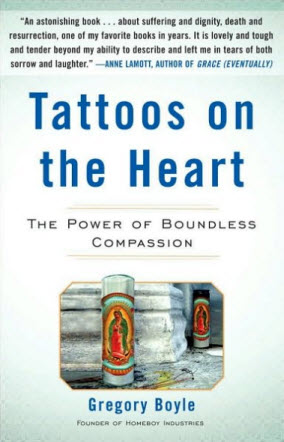
Tattoos on the Heart

I'm always pleased when I hear a story of how a man has reached out and had a positive impact on the life of a young male. Every once and a while, however, a story of a dedicated man, influencing (and sometimes saving) thousands of lives, just takes my breath away. This post is a book review by guest contributor Peter Sullivan. The book is, Tattoos on the Heart - The Power of Boundless Compassion.


I’ve recently read Tattoos on the Heart - The Power of Boundless Compassion by Father Gregory Boyle. Once I started reading it, I couldn't put it down. It is about a Jesuit Priest who has worked for over twenty years in a gang-intervention program. The program is located in a neighborhood of Los Angeles, CA, a community with a high concentration of murderous gang activity, over a hundred different gangs, and in what many consider to be the gang capital of the world. What Father G (as the boys call him) started is now called Homeboy Industries, a collection of business created to, assist at-risk and formerly gang involved youth to become positive and contributing members of society through job placement, training and education.

For anyone interested in mentoring boys, I don’t think there could be a better role model than Father G. Because he is loved, respected, and trusted, he is able to have a powerful influence on the young guys around him. The subtitle of the book, "The Power of Boundless Compassion" speaks to Father Boyle's approach, and is dominant force you can feel in his work.


I was very deeply moved by Father Boyle's descriptions of the lives of the young men around him. The struggles they go through, the poverty, the violence, the need to keep up their "rep", as well as their loneliness, humor, and humanity. I came to actually admire and care about each character he portrayed. Because of my attachment to them, I also felt a deep sadness when, just as these young men were beginning to make progress and experience success, they would often be cut down in a senseless drive-by shooting or other violence. These individual stories are woven into parables that spoke directly to my heart in a way that the spiritual lessons couldn’t be missed and which profoundly changed my world view. Here is a quote from the book, which also describes what happened to me:
“If we choose to stand in the right place, God, through us, creates a community of resistance without our even realizing it . . . Our allocating ourselves with those who have been endlessly excluded becomes an act of visible protest. For no amount of our screaming at the people in charge to change things can change them. The margins don’t get erased by simply insisting that the powers-that-be erase them . . . The powers bent on waging war against the poor and the young and the “other” will only be moved to kinship when they observe it.”
I am part of a small group in my community called Just Faith. It's a program to encourage learning about social justice issues and then taking actions to help change things. In “Tattoos on the Heart" I was indeed "moved to kinship," and motivated to do what I can do to make a difference in the lives of the young men around me. For starters, we will be visiting homeless shelters in Camden, New Jersey. I am developing a plan, with others, to consider how we can move into action based on what we learned from Father Boyle’s book. I highly recommend it to the readers of this blog.


Tattoos on the Heart teaches us how to fight despair and to meet the world with a loving heart. It's a story of people overcoming shame and hopelessness and learning to stay strong in spite of failure. Maybe most importantly, it clearly demonstrates the impact unconditional love and boundless compassion can have in the lives of those giving and receiving it. Here is a short video clip describing Homeboy Industries and Father Boyle's work:


If the clip is not visible go to THIS LINK.

"Building prisons to address crime
is like building graveyards to address AIDs"

Father Gregory Boyle


LIKE: If you enjoy this blog, please visit the Man-Making Facebook page and click the "Like" button.

TWEET: Send this post along to your friends or follow me on Twitter!

SUBSCRIBE: If you're not yet a subscriber to the Man-Making Blog, and you'd like to receive these posts by email 3-4 times a month, go to this link for a free subscription.

CONTACT: Send Earl a message.

March 6, 2012

The Heartroot Nature Connection

Where I grew up in the city, there was a little acre or two of wilderness near my house. Not much by adult standards, but large enough for an 8 year-old adventuring boy. The place had “wild animals,” including rabbits, squirrels, and the occasional skunk. There was plenty of brush for hiding and ambushing intruders, animal prints for tracking, shade for hot summer days, and a few really old trees which seemed to anchor my urban forest. My small band of young-guy brothers knew every inch of that small wilderness. We knew the web of forest trails so well we could run them in the dark. We had secret hiding places, a meeting ground, and even built defensive “forts” to stand off unnamed enemies. It was a kind of wildness that truly fed my young boy spirit.

That little forest was also my backwoods escape place. It offered the comfort and soothing solitude I needed when the insanity of my alcoholic family home life was approaching more than I could bear. By high school, that wilderness had shrunk into irrelevancy as girls, cars, and school became way more important. But I have never forgotten that little patch of sacred ground. Did you have a place like that when you were a kid?

As I grew into adolescence and then on toward adulthood, there were no men around to teach me the masculine arts of hunting, camping, canoeing, and wilderness navigation, much less take me into the wild places. I have pretty much remained a "city kid." In fact, I’m still a little embarrassed around men who comfortably make their way into the wilderness and, occasionally, take me along. They now call that condition, Nature Deficit Disorder, or NDD, a term coined by Richard Louv in his 2005 book, Last Child in the Woods. NDD is most simply defined as the human costs of alienation from nature, and it's the counter-point to my boyhood fondness for places green and wild.

When Luc Tunkel wrote to me about his work with Heartroot Nature Connection, the memory of the wild and natural place of my youth came to get me . . .along with my fear of the big outback. Luc, it turns out, is just what NDD males need. He is someone who can gently introduce guys to the wilderness in ways that minimize fears while building a skill-based confidence and a love of things natural.

The title of Luc’s website says it all, Heartroot Nature Connection. Through his training experiences, he offers, what he terms ancestral skills, a way of learning to live in a mutually beneficial relationship with the natural ecosystem. Just some of the skills Luc can help you learn include: crafting your own bow and arrows for hunting, and the ancient arts of shelter building, friction fire making, tracking, fishing, backwoods navigation, and gathering edible and medicinal plants.

Just a few of those talents would greatly increase my confidence and comfort in going into the great outdoors. The best part of Luc's training is you get to learn these skills in his backyard, the mountains and backwoods of Montana. Now that’s one large, beautiful, green, and wild patch of sacred ground!

If you want to get a small sense of what it’s like to actually have a heartroot nature connection, read this inspirational Springtime Prayer Luc wrote last March. Reading it made me want to be him and experience nature through my pores and whole being. The prayer begins with these lines:
Let the Thaw be witnessed by untainted senses, understood without judgment or expectation. May my squishy footsteps bring me to yet unexplored expressions of Truth. Let my voice ring in resonance with birdsongs, welcoming the lengthening of days and renewed growth. (read more)
Instead of wanting to be Luc, as an NDD guy perhaps I should just pack up and go spend a week with him in Montana. Maybe I'd begin to develop my own Heartroot Nature Connection. I think I need to better understand what I have lost, or maybe never developed, as a man in relationship to the natural world.

If you had training in the great outdoors by the men around you while you were growing up, tell us about it. Add it to the comments section of this post or send me a note and I'll add it for you.

If, however, you are an NDD guy like me, imagine how the man you are today would be different if, as a boy you had men like Luc around for guidance. Men who could help you harvest all the gifts of discovery, personal and natural, waiting in the great outdoors. Then you may want to consider the young males around you today who have never left the worlds of cement, asphalt, artificial, man-made, the mall, and digital places. Can you think of a way, possibly along with some of your men friends, to give those guys the gift of a visit to a wild and green place?


LIKE: If you enjoy this blog, please visit the Man-Making Facebook page and click the "Like" button.

TWEET: Sent this post along to your friends or follow me on Twitter!

SUBSCRIBE: If you're not yet a subscriber to the Man-Making Blog, and you'd like to receive these posts by email 3-4 times a month, go to this link for a free subscription.

CONTACT: Send Earl a message.