The Man-Making Blog is a practical and inspirational resource
for people interested in supporting our young males
on their journey to manhood.

Showing posts with label guest blogger. Show all posts

August 17, 2015

Men Holding Space for Young Guys


In my work with young men, I often hear the term, “holding space.” It means a lot of things really. For me it’s primarily about keeping a place in my heart and mind for the multitude of sad, angry, brave, lonely, and under-male-supported young men I know who are out there and lost on their journey to manhood.

The most common use of the expression, “holding space,” refers to the creation of a safe, gentle, and non-judgmental environment for young guys on our events, outings and in our school and other group circles. We refer to it as creating a safe container that can hold the hard questions, expressions of deep wounds, joys, anger and anything else that's found behind the brave, “I’m Okay” boy mask. It's the space inside that container, where deep truths can be spoken, that we hold and protect.

“holding space” refers to
the creation of a safe, gentle, and
non-judgmental environment for young guys

One way of teaching men to hold space and to keep the container strong is by teaching them our basic group-mentor’s job description. While it may be slightly altered in different places in our network, basically it’s to LAMP and not to FRAP young males! LAMP means to Listen, Accept, Model, and Praise. These behaviors are gifts people can give each other in any relationship and which increase trust and connection. FRAP is what we try not to do. Fix, Rescue, Advise, and Project. FRAP-ing behavior quickly reduces and erodes the trust that is the glue in any container. You can read more about these skills in this past Man-Making Blog post on the topic.

Matt Zavadil, a true brother in mission and the program director for Boys to Men - Georgia, came across the term “holding space” in an article he was reading. He sent the following contribution for your consideration.


Earl, I recently read a great blog post from a woman who learned how to support her mother's dying process. It's full of tremendous insight and the wisdom she gained going through the experience. The term she uses is "holding space" and it perfectly describes what we do for the boys in our programs.

Holding space seems so passive on one hand, and yet, OMG, it is not! For me, to really hold safe space for a young guy, I need constant vigilance to corral my every impulse to look smart, anticipate a kid’s meaning, push for a specific outcome, feed my own ego, or somehow make it about me. After reading this post, I realize holding space, at its core, is one of the strongest acts of love there is.

Here are lessons the author learned from her experience of holding space for her mother in that most difficult time:
  • Give people permission to trust their own intuition and wisdom.
  • Don’t take their power away.
  • Keep your own ego out of it.
  • Make them feel safe enough to fail.
  • Give guidance and help cautiously, with humility and thoughtfulness.
  • Create a container for complex emotions, fear, trauma, etc.
  • Give people only as much information as they can handle.
  • Allow them to make different decisions and to have different experiences than you would.
The author goes into more detail about each of these themes in her article. Let’s share these ideas with people who are working with young guys.


How would you feel if you were able to sit with a group of good men who were committed to holding space for you? What would it be like for you to be in a place where you felt safe because trust in each other was high, and where your real, unedited, truth-speaking self was welcomed and honored? It’s in that environment where real man-making takes place and where all the participants move along on their journey to manhood.


SHARE: If you enjoy this blog, please click the Facebook "Share" button below to support the Man-Making Facebook page! (The button is only on the MM Blog, and not in subscription posts delivered by email.)


CONTACT: Send Earl a message. I'm very interested in your thoughts on any man-making post or topic. I'm available to help bring man-making initiatives to your community or organization.

SUBSCRIBE: If you're not yet a subscriber to the Man-Making Blog, and you'd like to receive these posts by email 3-4 times a month, use this link for a free subscription.

TWEET: Send this post along to your friends or follow me on Twitter!

June 17, 2014

Supporting Fatherless Boys

Dave Bolduc is a Man-Making Blog subscriber, contributor, and true brother in mission. In the following story Dave reacts to the recent Man-Making Blog post titled Un-Father's Day, and describes how and why he shows up for the fatherless boys.


I am one of those guys Earl mentioned in his last blog post about Un-Father's Day. While my relationship with my dad was pretty good, we never really connected at a deep level because we really didn't know how to communicate our feelings to each other. He died unexpectedly one night, so I didn't get a last chance to have that important conversation, or even to say goodbye for that matter. I know he loved me and was proud of me; we just never put those feelings into words. I guess that's why, for me, working with young guys is so important. I want them to know they are really cared about.


I'm involved with a chapter of the Boys to Men Mentoring Network here in Virginia (BTMVA). In our group, I'd say most of the young men don't have a father present in their lives, and many of the boys never even knew their dads. In the picture below you'll see seven boys who are now J-Men, Journeymen graduates of our Rite of Passage Weekend on their graduation from 8th grade. Not one of them is connected with his father. The guys are from the projects, but they are kids lucky enough to go to a school, get a free education and at least a chance to succeed.


The picture on the right is me having a farewell dinner with a sixteen year-old boy named Robert. He was another one of our guys whose father was not in his life. Three years ago Robert was able to reconnect with his dad. With the skills he learned in BTMVA, and lots of support, after only a few months he was able to communicate with his dad and do his part to make their relationship strong. In BTMVA we helped Robert find new ways to express and deal with his considerable anger. That kept him out of trouble which made his dad proud.

. . . at least he's had a chance to speak to his father
and tell him he loves him.

Unfortunately, Robert is getting shipped off to live with his aunt and uncle for the summer, and he will likely be there until he turns 18. In reality, it' a better place for him to live rather than just roaming the streets bored. But his dad is dying and it's unlikely he'll be able to be with him when he dies. My heart aches for him. It's like my situation, but at least he's had a chance to speak to his father and tell him he loves him.

Supporting these guys in our Boys to Men group is how I give back. I do it for them to be sure, but I get so much back in the process. One example of how we support these boys is that on Father's Day, myself and seven other men accompanied eighteen boys to King's Dominion Amusement Park. The young guys were really excited about the giant rides, food and fun. I have to say I had a great time too. I know they loved the day out and important memories were created for everyone.

I really encourage more men to get involved. If you want some ideas about what you can do, give Earl a shout, or send me an email at dbolduc@kcc.com. Or simply look around! I'm pretty sure without looking too hard you can find an organization supporting fatherless boys in your community. Like our Boys to Men organization, they will very much appreciate your time. I guarantee the young guys will love it too, and you'll be a better man as a result.


SHARE: If you enjoy this blog, please click the Facebook "Share" button below to support the Man-Making Facebook page!


CONTACT: Send Earl a message. I'm very interested in your thoughts on any man-making post or topic. I'm available to help bring man-making initiatives to your community or organization.

SUBSCRIBE: If you're not yet a subscriber to the Man-Making Blog, and you'd like to receive these posts by email 3-4 times a month, use this link for a free subscription.

TWEET: Send this post along to your friends or follow me on Twitter!

March 17, 2014

Teaching Young Men To Prevent Sexual Violence

Tim Wernette is a Gender Equity Educational Specialist with the University of Arizona/AZ Department of Education, and a regular contributor to the Man-Making Blog. He has been involved with the pro-feminist men's movement since the late 1970s and has volunteered at the Tucson rape crisis center doing educational outreach. He sent along this personal story about how sexual assault touched his life when he was a young man.


What today I know was a sexual assault happened at the house I was renting with some other guys near Michigan State University. It happened in the late 1960s when I was a young man in my early 20’s. I was a naive, sexually inexperienced, and ignorant college kid. It was also in the days before the women’s movement and feminism. The short story of what happened is one of my roommates picked up a high school girl he knew to party for the weekend. She was a virgin, he got her really drunk Saturday night, and he took her upstairs to his bedroom and had sex with her. After more than forty years, my memory of the details is a little hazy, but the feelings of sadness, regret, and guilt for not saying or doing anything to prevent that act are as vivid as ever.

. . . the feelings of sadness, regret, and guilt
for not saying or doing anything
to prevent that act are as vivid as ever.

In those days people didn’t talk about “date rape.” If they talked at all about men and sex, it was all about a guy’s high sex drive and need to score, or women asking for it by dressing/acting seductively. Rape is what happened in some dark alley or park, and was done by a sleazy stranger. There wasn't any education about sexual assault or date rape. Any prevention messages you might hear were all directed to the women: Don’t go out alone at night; Don’t drink too much; Take a self-defense course and learn how to protect yourself. The unspoken message was “boys will be boys,” or maybe even, it's okay for boys to be boys and act out sexually. At the time of the incident, my feelings aside, I really didn’t realize my roommate was actually doing anything wrong.

Today, it’s called sexual assault and it’s understood that it’s not really about sex, but about violence, power, and feeling control over someone. We also know that most sexual assaults are committed by someone the target knows, an acquaintance, a friend, a partner or even a husband. In addition to educating girls/women about the dangers of sexual assault and how to protect yourself, today, boys/men are also being taught about sexual assault and the dangers for men as perpetrators and as potential targets.


In addition, there is a new front line in the sexual assault prevention arena. It’s a focus on the bystander(s). Bystanders can be anywhere along a continuum from actually doing nothing and supporting the assault (as I did), to stepping in with actions to prevent the assault. One solid article on that topic is from the New York Times titled, Stepping Up to Stop Sexual Assault. The article explores this new terrain where both women and men can intervene with both gender targets and perpetrators to stop sexual assault before it happens. Among the interesting facts, the article mentions somewhere around 3% of college men account for 90-95% of campus rapes. The goal is to get the other 97% of guys to “come into the room and help with the problem.”

Research shows that if one person stands up and intervenes, others will also; but if no one stands up, others won’t either. This challenges all of us to develop the courage and skills to step in and keep a possible sexual assault from occurring. I’m still haunted by the look on the girl’s face when she came down for breakfast Sunday morning, and her fear, shock, and bewilderment about what had happened to her the night before. I want to do what I can to insure our young men know how to stand up for potential victims and have the courage to do so. I don’t want anyone to have to live with sadness, regret, and guilt for not intervening.


For those working with young men, there are lots of resources on the web that can help with formal and informal bystander intervention training; just Google it. As the New York Times article, which Tim mentioned, points out, when one guy gets in the way of another guy in pursuit of getting laid, it’s not called “bystander intervention,” but “shot blocking” and there is some considerable skill involved. In the educational campaign from the University of Massachusetts, Amherst, their website suggests a simple formula called The 3 Ds of Active Bystandership. The 3 D’s are Direct, Distract, and Delegate.

Here is a short video clip showing a skilled active bystander in action. He’s using a slightly different formula, Disrupt, Distract, Redirect, but it’s a great example of what might be possible.


If this clip doesn't show up use this link.

If you have a way to do it in a group or just in a conversation, take the risk to let young men know where you stand on sexual violence. Keep it simple, show a video, or have a conversation about this blog post. Offer your own version of bystander training and in doing so, let them know when it comes to sexual violence, you have to take a stand. It might just prevent very painful consequences in the lives of some of the young men and women you know.


CONTACT: Send Earl a message. I'm very interested in your thoughts on any man-making post or topic. I'm available to help bring man-making initiatives to your community or organization.

SUBSCRIBE: If you're not yet a subscriber to the Man-Making Blog, and you'd like to receive these posts by email 3-4 times a month, use this link for a free subscription.

LIKE: If you enjoy this blog, please click the "Like" button below to support the Man-Making Facebook page!

TWEET: Send this post along to your friends or follow me on Twitter!

January 18, 2014

Movies for Men and Boys: The Way, Way Back

This review of the film, The Way, Way Back, was contributed by Brian Mier, a Men's and Boys’ Health Promoter with Eagle Health Resources in Melbourne, Australia.


Ultimately, The Way, Way Back is a joyful movie. Generally, the critics gave it a favorable rating, but those of us with a passion for man-making with boys will understand the deeper beauty in what is, at times, a hard story to watch.

In the story, fourteen-year-old Duncan goes on holiday with his divorcee mother, Pam, and her boyfriend, Trent. The boyfriend is a puffed up and over-bearing man who is constantly belittling Duncan in a way which basically constitutes psychological and emotional abuse. As a result, Duncan, who is already shy, isolated, and angry, becomes even more sad and his self esteem sinks even lower.

Feeling (and being) very alone, Duncan takes off on his bicycle to explore the seaside town on Cape Cod. He comes across the Water Wizz water park. The park becomes his escape from the uncomfortable adult antics at his summer home. At the water park, he is befriended and mentored by some very unlikely but very good men (and women). Mentoring occurs in unusual ways and in the most unusual places.

As the film progresses, we watch Duncan grow through his coming of age, young male experiences. He develops a supportive, puppy love relationship with the girl next door. At the park, he begins to have fun, learns some lessons about “women” from the men, he accepts some responsibility, contributes his ideas to the business, and earns some praise in the process. As a result of these experiences, his self-esteem, confidence, and courage all come to life.

The Way, Way Back also has a positive message for parents. It illustrates what psychologist and parenting educator, Steve Biddulph, says is a very important parenting equation, TIME = LOVE. Fortunately, this is exactly the lesson Duncan’s mom Pam learns the hard way.

. . . a very important parenting equation,
TIME = LOVE

Superb acting by perfectly cast actors made this film a joy for me to watch. In the clip from the movie below, you'll get a sample of both the ups and downs of Duncan's summer experience. I confess to having a tear in my eye occasionally because the stories of Duncan’s adolescent adventures were close to home for me and apply to so many adolescent boys. Critics called it “funny and sweet”, but it’s much more than that.

If you really care about teen boys, I think you’ll love this movie.


If this clip doesn't show up use this link.


If you haven't yet had a chance to offer your feedback on this blog, please go to the Annual Man-Making Blog Survey and answer four quick questions. Survey closes the end of January. Your input is very important to keeping this content relevant to you, the readers.


CONTACT: Send Earl a message. I'm very interested in your thoughts on any man-making post or topic. I'm available to help bring man-making initiatives to your community or organization.

SUBSCRIBE: If you're not yet a subscriber to the Man-Making Blog, and you'd like to receive these posts by email 3-4 times a month, use this link for a free subscription.

LIKE: If you enjoy this blog, please click the "Like" button below to support the Man-Making Facebook page!

TWEET: Send this post along to your friends or follow me on Twitter!

January 17, 2013

About Boys, Men, and their Fathers

olyf.com
I've sat in a lot of circles with guys of all ages. It’s very often the case, maybe always the case, that when the conversation comes around to fathers, most guys have a lot to say. For so many, it’s a difficult story to tell.

As a part of training men to work with young males, we bring them back to the relationship with their fathers to help them get at any emotional residue. We want them to be in fresh contact with their father issues, feelings and hungers. By reconnecting with the complexity in that relationship, they are better prepared to support so many of the young males who are struggling to understand and cope with what is going on with them and their fathers. It’s bitter-sweet work that often leads to supported healing for all the men involved.

Two Man-Making subscribers have submitted the following poetic expressions describing the love, longing, sadness, maybe even hopelessness they have in their relationship with their fathers. Let’s see what they bring up for you.


In a very personal poem written by contributor Rick Belden, he tells a story of his relationship with his father as represented by an array of his father’s tools.


tools my father gave me
wrenches
hammers
socket sets
screwdrivers
pliers
a hacksaw
and so on
are laid out on cardboard on the living room floor
it looks like an autopsy scene
       what caused this person to die?
or a forensic examination site
       what caused this plane to crash?
or the results of an archaeological dig
       what was this lost civilization like and why did it fail?
each object carefully positioned just as it was found
waiting to be tagged
documented
and taken off to the museum.

these are the tools my father gave me
as christmas presents when I was a kid
the contents of a big
chunky clunky
heavy as hell
old rusty metal toolbox
       also a christmas present
       from my dad
I don't know what to do with this stuff
the part of me that dislikes disorder wants to
       put it all away
       or get it out of here
but I think it's exactly as it should be for now
       spread out on the floor
       like the contents of an open grave
and I'm gonna leave it that way for a while
a monument in progress
to a lost cause I've finally turned loose.

for almost fifty years I continued to hope
that I could work it out with him somehow
that we could have some big breakthrough
if I could just figure it all out
if I could understand him
       what he wanted from me
if I just had enough time
if I was just smart enough
to work it all out.

but
I finally had to admit defeat
I finally had to let it all go
because I finally knew beyond a shadow of a doubt
that it was never gonna work
       no matter what I did
       no matter how hard I tried
       or how long I tried
it was never gonna work
I was never gonna be what he wanted
and he was never gonna be what I wanted
       or give me what I needed
       no matter how much I needed it
it simply wasn't gonna happen
ever.

nothing I did
       or didn't do
       or could have done
no amount of patience
       or waiting
       or forgiving
       or confronting
       or achieving
       or accommodating
was ever gonna change anything between him and me
that's just the way it is
was
and always will be.

so here I am
with the tools he gave me
       all laid out on the floor
       like dinosaur bones
       waiting to be reassembled
they've been there
just like that
for over a year now
       a dusty little metal graveyard in my living room
       a free-form sculpture in iron and steel
of grief and loss and never was.

Copyright © 2008 by Rick Belden, - rickbelden.com - Author of
Iron Man Family Outing: Poems about Transition into a More Conscious Manhood


Michael Sterling said, An incredible song / poem came into my life recently - a love song from a man to his father. For years, I hated and raged at my father. After living my own mistakes, I've learned to have compassion for him. This poem, Mi querido viejo (My dear old man), by Piero, it speaks to this journey in both the man and his son. I offer this with thoughts - sadness, compassion, forgiveness & gratitude for Ron, my father passed.
My Spanish isn't native or perfect, but listen deep to the words in this translation and you will feel it all:


Viejo mi querido Viejo / My dear old man

He's a good man my old man
He travels alone and waiting
He seems sad
from so much traveling

I look at him from afar
but we are so different
he grew up in the century
with tramcars and wine

Old man, my dear old man
now you walk so slowly
as if you were forgiving the wind
I am your blood, my old man
I am your silence and your time

He has good eyes
and a heavy figure
Age came upon him
Without show, without audience

I have the new years
and the man, the old years
He holds his pain inside
and his stories are timeless

My old man, my dear old man
no you walk so slowly
as if you were forgiving the wind
I am your blood, my old man
I am your silence and your time
I am your blood, my old man


In this clip Piero singing Viejo mi querido Viejo in Spanish,
accompanied by some wonderful graphics.


If the video doesn’t appear above use this link.

Did these expressions touch something in you? If you’re inclined, use the comments section below to post to share your reaction. If you’re and email subscriber, send me a note directly and (if you’re willing) I’ll share it with others in the comments to the post.


LIKE: If you enjoy this blog, please click the "Like" button below to support the Man-Making Facebook page!

TWEET:  Send this post along to your friends or follow me on Twitter!


SUBSCRIBE:  If you're not yet a subscriber to the Man-Making Blog, and you'd like to receive these posts by email 3-4 times a month, go to this link for a free subscription.

CONTACT:  Send Earl a message.

November 28, 2012

Mentoring Young Men Toward Healthy Sexuality

One of the more challenging aspects of becoming a man is navigating the mine field of male sexuality. Every adult man can remember the powerful sexual feelings, as well as the anxiety and confusion around sex they experienced as a teen. While this is a huge topic, a step toward addressing this challenge comes from a regular Man-Making Blog contributor, Tim Wernette. Tim is a Gender Equity Educational Specialist with the University of Arizona, and in this post he describes a helpful book on this important topic. Apparently, we can now add myths about men and sex to the list of barriers between a young man and a healthy male sexuality.


Our society is very schizophrenic about sexuality. On the surface it seems like we’re open about sex because it seems to be everywhere. You see allusions to sexuality in films, product advertising, in popular music, and even in the video games young guys are playing. Certainly internet access has made sexual images and information almost universally available for better and worse. And then there are the sordid tales of male sexual perpetrators so often in the news these days. With all that going on, there is often not enough good and credible information about sex and sexuality available from trusted sources. The result is a confusing prescription for healthy teen sexuality, and some powerful myths our young guys (and some men) will have to deal with on their way to manhood.

In his book, The New Male Sexuality, Bernie Zilbergeld explores some of the subtle myths about male sexuality which boys and men often encounter. These messages are clearly seen in pornography, but occur in other parts of the culture, too. If you’re not aware of them, these myths almost guarantee problems and pain in relationships if they are internalized by our young men. Here are just a few:

(For a full list go to the end of the post.)

Men Are Always Ready and Willing to Have Sex: The truth is males are not always ready to go, and can certainly have pre-conditions for having sex just as women do. In fact, the author, in his research, discovered 30% of men felt, at least sometimes, that sex was a burden. This “always willing” message discourages males from understanding, acknowledging and respecting their own terms for physical (or any kind of) intimacy. Feeling like you should always be ready to have sex can easily lead to embarrassment, sexual dysfunction, and other problems in relationships.

Sexuality = Performance = Competence: For many boys/men, sex becomes a proving ground for our sense of masculinity. A young man who has lots of partners is considered a “stud” or “player,” and often looked up to by other males. The irony is that the more pressure a male feels to perform, the more likely he is to have sexual problems. This message encourages males to consider sex as another platform on which to achieve success (and risk failure), and interferes with intimacy with one’s partner.

Size matters: This one is ancient in guy lore. As young men, we see all the (normally) different sized penises in locker rooms or even in pornography. Lacking a broad enough sample, questions about the size of your member and how that relates to performance, not to mention virility, easily come to mind. The truth is a short course on female anatomy and intimacy will quickly help a young man realize sexual pleasure, yours or hers, has very little to do with penis size or even shape, and is more about the chemistry between two people that count.

As adult male mentors and role models, we should consider these (and other) poor messages about sex and sexuality we have grown up with. If we take the time to explore the problems they have created for us, both our struggles and successes in overcoming them, we’ll have important wisdom to offer the young men in our lives. In sex and sexuality, as in all aspects of becoming a man, our young men need our support on their journey toward manhood.


Tim is so right, good men can be an enormous help to young guys in taking on this critical component of becoming a good man. Men can support young males by offering credible information when asked, sharing personal experiences as appropriate, and inviting young guys to talk about their thoughts, feelings, and confusion.

In this era of sexual abuse scandals, there is an increased need for solid and informed men who are willing to talk to young males about sex and sexuality. HOWEVER and almost sadly, to protect those men and boys today, we have to be sure those conversations take place in safe and appropriate settings.

To see a full listing of the myths about male sexuality, and a whole lot of other myth-busting and high quality data on the topic of sexuality in general, go to the Sexuality Education Resource Centre of Manitoba website.


LIKE: If you enjoy this blog, please click the "Like" button below to support the Man-Making Facebook page!

TWEET:  Send this post along to your friends or follow me on Twitter!


SUBSCRIBE:  If you're not yet a subscriber to the Man-Making Blog, and you'd like to receive these posts by email 3-4 times a month, go to this link for a free subscription.

CONTACT:  Send Earl a message.

October 28, 2012

Fire Circles - Opening the Hearts of Men and Boys

This article is offered by Allan Rudner, a brother in mission, working in Sydney, Australia. It's his personal story about his powerful connection to fire and how he is using it to create new connections between diverse communities of men and boys.


Since boyhood, I have been called to fire. I grew up in South Africa, living half a block from bushland, where I spent many happy hours on my own or with boyhood friends. From time to time, a wildfire would break out and the flames could be seen leaping high into the sky. I remember getting as close to the fire as I could and feeling my heart pounding inside me. I could actually feel the raw wildness and energy of the fire coursing through my veins. In those moments, I was in complete awe and knew I had found my passion!

Now, after working with boys and men in the wilderness for the last twenty years, that passion for fire is back in full force, and its call is powerful. Over the years, my Rites-of-Passage work has always included some relationship to fire. It has always accompanied rituals and ceremonies, signifying the transitions from boyhood to manhood and manhood to Elder. But currently, I’m called to fire circles!


Today, I’m using the timeless and primal notion of The Fire Circle to connect diverse groups of older men with younger men/boys. In these circles, older men take their place as leaders and mentors within the community, and younger men/boys have access to a network of positive male role models. My approach has been carefully crafted to ensure a sense of safety and caring for everyone. Using ritual and ceremony around the sacred fire, men and boys are introduced to respectful and confidential processes for sharing personal stories. The goal is for everyone to have an opportunity to be listened to and to be heard.

After a couple of hours together in a typical fire circle, the group formally closes the space and then retires to an area where food is shared. The impact of the time around the fire is always obvious as the group mingles, talks, laughs and, informally, connects with one another.

From the feedback I've gotten, it is clear The Fire Circle experience is very much appreciated and valued. Here are a just a couple of the (common) comments I get from participants:
"I thought your fire circle was beautifully established and run. It was just the right blend of gentle firm guidance and freedom/space for personal responsibility. I feel that evening living in my body right now. I encountered myself in a new way and with magical universal input. The timing was spot on. It augmented my ability to try to be differently with my son, my brother and father." - RK
"I believe you got the recipe right last evening, around the warmth of the fire and in the spirituality of the Tepee. Twenty-two men, of such varying age and divergent backgrounds, would normally have passed each other by along the path of life with barely a spoken word, perhaps, at best, a nod. By creating a space of safety and oneness of purpose, the differences between all these men were relegated to a position of minor significance. The common desire for personal growth, the sharing and purpose, shone forth in openness and truth. I am enriched for the experience. Thanks." - Ralph
I believe The Fire Circle process is creating a valuable community resource by building more connections between diverse men and strong inter-generational relationships. The Fire Circle creates new roles for older men in our communities, and the youth benefit by being witnessed and accepted as they are by Elder men. In short, it's exciting for me to watch this process building stronger and more cohesive communities.

At the personal level, The Fire Circle is how I find my way to my spiritual home. No sooner do I seat myself around the fire than I feel a flood of peace and alignment, which so often eludes me in the “outside world.” When I see the opened heart of a lad or a man, I feel the energy flowing inside me. When guys "get it," and the tears flow, and their woundedness is shared, my heart melts, and I know I am doing something important. Helping to open men's hearts and seeing them come awake gives me the juice I need to keep going. I believe when a man has an open heart, the world is a better place.


Currently The Fire Circles take place at different venues in and around Sydney, Australia, with a growing interest in hosting them in other areas. If you want to connect with Allan to learn more about his fire circle process, check out his LifeCrating website, or visit The Fire Circle Facebook page. You can also email Allan Rudner directly.


LIKE: If you enjoy this blog, please click the "Like" button below to support the Man-Making Facebook page!

TWEET:  Send this post along to your friends or follow me on Twitter!


SUBSCRIBE:  If you're not yet a subscriber to the Man-Making Blog, and you'd like to receive these posts by email 3-4 times a month, go to this link for a free subscription.

CONTACT:  Send Earl a message.

April 25, 2012

Manning Up: Women's Rise - Men's Demise?

The following book review was contributed by Guest Blogger, Joshua Slattengren. If you would like to write for the Man-Making Blog, please contact me.


In her book Manning Up: How the Rise of Women has turned Men into Boys, author Kay Hymowitz looks at the social trends which have created what she terms the “child-man.” She defines a child-man as a male in his twenties or early thirties who lacks the motivation for taking on the various responsibilities often used as metrics for manhood - such as holding down a “real job,” marriage, and starting a family. Instead, the stereotypical child-man is a responsibility-shirking, slovenly-dressed, video-gaming, South Park-watching slouch.

According to Hymowitz, child-men find themselves lost in a world where women make more money, are more educated, and are less likely to want to settle down (with them) and build a family. Publisher’s Weekly (which panned the book) quotes the author, describing pre-adult men as, . . . living in a world where social demands no longer equate manhood with maturity, (thus) frat dudes, nerds, geeks, and emo-boys can remain in suspended post-adolescence, while women, whose biological clocks are ticking, are forced to choose between single parenthood and casting their lot with a child-man. Hymowitz explores the many cultural forces she believes have brought about this unanticipated and disconcerting effect in males.

Manning Up is less a prescription on how to reverse the child-man trend (though some ideas are presented), than a concise (fewer than 200 pages) historical and cultural analysis of the forces in society that have raised and tolerated the child-man. In a Forbes online interview with Hymowitz, the author describes some of the confusion for men resulting from the feminist movement. She said, . . . the culture at large is uncertain about what it wants from its men. We give a lot of mixed messages. We say, on the one hand, that fathers are so important. At the same time, we say that fathers are optional. Many women seem to want men that are confident and have a strong sense of themselves. At the same time, they are put off by too much masculine, authoritativeness. I think a lot of men react to these mixed signals by retreating into themselves, becoming passive and reluctant, and often waiting for women to make the first move.

Though she points to a number of factors driving men toward child-manhood, Hymowitz zeros in on the rise of the knowledge economy as a chief determinant. In the knowledge economy, it’s not male-favoring brute strength that is most highly prized, but emotional intelligence. She feels this emotional intelligence not only levels the job-market playing field for both genders, but may actually give women the upper hand.

Hymowitz suggests another important change she has witnessed over the last few decades is the infatuation with girl-power. The author doesn’t say empowering girls and young women is a bad thing – but this trend has changed the expectations and aspirations of women and, in response, altered the landscape for males in regards to education, marriage (marrying much later in life), and career opportunities. Hymowitz believes, in many ways, the pro-girl-power movement has come at the expense of boys and younger men. In just one example of many, she cites the major investments made in public schools to bring girls’ scores in math and science to par (or even better) with boys’ scores. She points out similar investments have not been made to raise boys’ reading scores to levels comparable to girls’.

The author also identifies another shift in the last few decades where popular culture increasingly portrays women as in-charge, competent, and sophisticated, while so many movies and TV shows portray men as the opposite: incompetent, unreliable, immature, and often foolish -- and only good for a laugh (think Adam Sandler, in Big Daddy, or Seth Rogen in Knocked Up).

What hit me as the most tragic result of changing social conditions Hymowitz describes is the absence of a positive and achievable life script in the lives of too many young men. In the past, Hymowitz writes,
The life script for most men was pretty simple: you’re born; you grow up; you learn to do the hunting, fishing, building, farming, and the like expected of you; you get married, you have children, you get old (if you’re lucky); and you die. There were exceptions [… but] despite the variations, we can make several generalizations. First, men were required to provide, or to help provide, for their wives and children, and in many cases for other family members. Second, in the face of danger, they had to protect these others as well. This is why so many pre-modern cultures had initiation rituals testing boys’ courage, perseverance, and competence.
In the past, societies needed proven men – especially at times of war and high risk. In the modern knowledge economy, men are simply not needed in the same way. It’s a mistake, though, to assume that men are, therefore, dispensable. It frustrates me that we have allowed society to diminish the role of the strong and responsible man – or have so dumbed down manhood so as to equate it with sex, beer, computer games, sports and foolish pursuits.

It can and should be argued, as this blog often does, that the risks we are and will be facing in our world will require tested, proven, and responsible men. This in no way precludes a role of strong women and women of character. But a clear template for men does seem to be missing.

Manning Up shows us how the challenge of coming of age for a young male in a culture without a desirable prescription for a positive and mature manhood, combined with a lack of guidance from older men, has resulted in something like the child-man phenomenon the author describes. In spite of what you might consider to be its flaws, the book does provide the reader with a greater awareness of social trends affecting not only our young men, but also women and society as a whole. I highly recommend the book to anyone interested in what Earl, in this blog, terms man-making.


(The author of this review is Joshua Slattengren. He is 32, is newly married, and resides in Indiana. He has been a teacher, was involved in coaching, and has served overseas in the Peace Corps. Currently, Joshua is a manager at a college bookstore.)


LIKE: If you enjoy this blog, please click the "Like" button below to support the Man-Making Facebook page!

TWEET:  Send this post along to your friends or follow me on Twitter!


SUBSCRIBE:  If you're not yet a subscriber to the Man-Making Blog, and you'd like to receive these posts by email 3-4 times a month, go to this link for a free subscription.

CONTACT:  Send Earl a message.

March 16, 2012

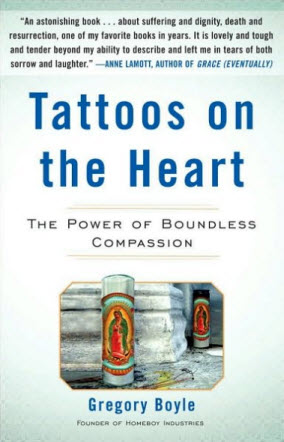
Tattoos on the Heart

I'm always pleased when I hear a story of how a man has reached out and had a positive impact on the life of a young male. Every once and a while, however, a story of a dedicated man, influencing (and sometimes saving) thousands of lives, just takes my breath away. This post is a book review by guest contributor Peter Sullivan. The book is, Tattoos on the Heart - The Power of Boundless Compassion.


I’ve recently read Tattoos on the Heart - The Power of Boundless Compassion by Father Gregory Boyle. Once I started reading it, I couldn't put it down. It is about a Jesuit Priest who has worked for over twenty years in a gang-intervention program. The program is located in a neighborhood of Los Angeles, CA, a community with a high concentration of murderous gang activity, over a hundred different gangs, and in what many consider to be the gang capital of the world. What Father G (as the boys call him) started is now called Homeboy Industries, a collection of business created to, assist at-risk and formerly gang involved youth to become positive and contributing members of society through job placement, training and education.

For anyone interested in mentoring boys, I don’t think there could be a better role model than Father G. Because he is loved, respected, and trusted, he is able to have a powerful influence on the young guys around him. The subtitle of the book, "The Power of Boundless Compassion" speaks to Father Boyle's approach, and is dominant force you can feel in his work.


I was very deeply moved by Father Boyle's descriptions of the lives of the young men around him. The struggles they go through, the poverty, the violence, the need to keep up their "rep", as well as their loneliness, humor, and humanity. I came to actually admire and care about each character he portrayed. Because of my attachment to them, I also felt a deep sadness when, just as these young men were beginning to make progress and experience success, they would often be cut down in a senseless drive-by shooting or other violence. These individual stories are woven into parables that spoke directly to my heart in a way that the spiritual lessons couldn’t be missed and which profoundly changed my world view. Here is a quote from the book, which also describes what happened to me:
“If we choose to stand in the right place, God, through us, creates a community of resistance without our even realizing it . . . Our allocating ourselves with those who have been endlessly excluded becomes an act of visible protest. For no amount of our screaming at the people in charge to change things can change them. The margins don’t get erased by simply insisting that the powers-that-be erase them . . . The powers bent on waging war against the poor and the young and the “other” will only be moved to kinship when they observe it.”
I am part of a small group in my community called Just Faith. It's a program to encourage learning about social justice issues and then taking actions to help change things. In “Tattoos on the Heart" I was indeed "moved to kinship," and motivated to do what I can do to make a difference in the lives of the young men around me. For starters, we will be visiting homeless shelters in Camden, New Jersey. I am developing a plan, with others, to consider how we can move into action based on what we learned from Father Boyle’s book. I highly recommend it to the readers of this blog.


Tattoos on the Heart teaches us how to fight despair and to meet the world with a loving heart. It's a story of people overcoming shame and hopelessness and learning to stay strong in spite of failure. Maybe most importantly, it clearly demonstrates the impact unconditional love and boundless compassion can have in the lives of those giving and receiving it. Here is a short video clip describing Homeboy Industries and Father Boyle's work:


If the clip is not visible go to THIS LINK.

"Building prisons to address crime
is like building graveyards to address AIDs"

Father Gregory Boyle


LIKE: If you enjoy this blog, please visit the Man-Making Facebook page and click the "Like" button.

TWEET: Send this post along to your friends or follow me on Twitter!

SUBSCRIBE: If you're not yet a subscriber to the Man-Making Blog, and you'd like to receive these posts by email 3-4 times a month, go to this link for a free subscription.

CONTACT: Send Earl a message.

November 29, 2011

Reaching Up for Manhood

GUEST BLOGGER: The following book review of Reaching Up for Manhood: Transforming the Lives of Boys in America by Geoffrey Canada, has been contributed by Tim Wernette. Tim is a Gender Equity Educational Specialist with the University of Arizona who speaks primarily to high school audiences in the hopes of changing the destructive aspects of gender stereotypes.

If you would like to be a guest blogger and review a book, a film, mentoring program or other resource with a man-making slant, please give me a shout.

One of the more malicious aspects of racism and classism is that disenfranchised people (the poor, people of color) are often marginalized and silenced. That’s why Geoffrey Canada’s Reaching Up for Manhood is especially important. He speaks to us from his experience as an African-American male growing up in the impoverished South Bronx, and as an adult mentor of boys in that community. His insight into the struggles most boys and men face is combined with his understanding of the special challenges faced by young, poor, inner-city boys and men. In the book’s preface, Canada speaks to all of us when he states:

“More and more I have become concerned with what boys think they should be, with what they believe it means to be a man. Our beliefs about maleness, the mythology that surrounds being male, has led many boys to ruin. The image of male as strong is mixed with the image of male as violent. Male as virile gets confused with male as promiscuous. Male as adventurous equals male as reckless. Male as intelligent often gets mixed with male as arrogant, racist, and sexist.”

In addressing issues of risk-taking, self-worth, fatherhood, and sex, Canada covers important ground. He also adds needed perspective on becoming a man when he discusses drug use in the lives of young men and how, when combined with unemployment, they create a devastating mix for many males living in poverty.

While Canada speaks eloquently about the urgent need for adult men to reach out to young males, I would especially encourage those who have programs that include manhood-initiation rituals to read his chapter “Mentors.” It discusses the impact gang membership and imprisonment has on many inner-city young men, and how the lack of understanding of cultural differences can lead to disastrous consequences:
"If we are to save the next generation of young boys, they need to be connected to men so they see examples of the possible futures they might live out as adults. At the same time, we have to be careful that we do not go charging into children’s lives without being properly prepared for the different ways they see the world. It’s as much an issue of class and culture as of race…We must spend time understanding what the children with whom we want to work are going through and living with every day…The gap between the poor and the non-poor, regardless of race, is growing ever larger in this country. Things many of us take for granted – safety, enough food, decent housing, a trip to the movies – poor children may have to struggle to obtain. This often creates circumstances where conflicts and hurt feelings between children and well-intentioned outsiders occur unintentionally."
Canada has written an important book about the importance of mentoring boys and young men, especially those disenfranchised by race and poverty. He has offered all of us an imperative to reach out to these young males, not just so they can avoid imprisonment and/or death, but so they can achieve their full potential and become constructive contributors to our society.


LIKE: If you enjoy this blog, please visit the Man-Making Facebook page and click the "Like" button.

TWEET: Sent this post along to your friends or follow me on Twitter!

SUBSCRIBE: If you're not yet a subscriber to the Man-Making Blog, and you'd like to receive these posts by email 3-4 times a month, go to this link for a free subscription.

August 17, 2011

A Boy's Rage In A Bottle

My name is Asia an I am a youth at (a youth center). I a 17 year old boy an I have lost a lot of people. I am reading your book on grief and loss. It is a good book. But I need help on other things to.

My mom is strung out on every drug you can think of. When I was 2 my mom sold me to a drug deler to pay them off for a deal. They put me in a floded basment and beat me. I spnt my life in the streets gangin and fightn. I shoot people, robed people shoot up peoples house n all that stuff. I wach my cousin get shoot in the face 7 times and that made me mad so I want to get even wit people and hut them. I hated the world. I hated everyone I seen. I got in lots of fights.

My grandad passd away and I had no one to go to but the streets. Every place the court sent me to I hurt people. Then I got lock up. It is hard, hurts I have alot lockd up inside me an I have been taking all this out on others all my life.

My life sucks. I never talk to no one. You are the only one I told this to. I think about killing my self all the time. Can you help me.

Asia
I hurt but never cry
I love but never loved
And still I stand


Dear Asia,

Thanks for writing me and sharing your story (and powerful drawing). I’m glad to hear you’re reading my book on grief and loss and I thank you for the compliment. I’m glad you like the book, I hope you find it helpful. It was written for young kids like you.

It makes me very sad and angry at the world that you, or any young dude, should be put through what you’ve experienced. My heart goes out to you. It’s hard for me, someone who knows a lot about the topic of grief and loss, to really understand how deep and crushing your sadness must be . . . . . and how strong a man you must be to deal with it all. It must be very difficult to hold all that pain inside you, and I can imagine you want to end it all sometimes.

From my experience, I do know that letting out that sadness, pain, and anger, in non-destructive ways, is where you have to start. I don’t know how you can do that, but keeping all that inside is like a poison. It  will make you crazy and keep you violent if you don’t. I’ve written to other guys in jail and I know that looking tough, being strong, and being on guard is necessary for survival. On the other hand, letting out the big feelings in the bottle you drew means being vulnerable, trusting someone, even letting down your guard. Eventually, doing that will make you a stronger man, but I don’t know how to tell you to do that where you are.

I do know that your true power as a man, your gifts, and so much that is awesome about you lies buried under all that hurt and sadness. Until that burden lifts, we won’t get to see the real “you.”

You are smart enough to read a book on the topic, and have enough faith to write to a guy you don’t know and share a little of your story. Those are good signs . . . really good signs. I’m proud of you for taking that risk. It gives me hope for you cuz you’re moving in the right direction. I hope you keep on taking those risks.

You asked me if I can help you. My response is that I can support you, but only you can help yourself. It will take real courage to face all that pain you have inside, but that’s my wish for you. You are worth it man. Take the risk. I’m on your side and I'm here for you.

Earl Hipp

Asia is out in the world now, living in Detroit, trying to be a good dad, struggling, but standing strong.


LIKE: If you enjoy this blog, please click the "Like" button below to support the Man-Making Facebook page!

SUBSCRIBE: If you're not yet a subscriber to the Man-Making Blog, and you'd like to receive these posts by email 3-4 times a month, go to this link for a free subscription.  

ADD TO YOUR SITE: It's easy to have the Man-Making Blog posts appear on your organization's website. Send me a quick message and I'll tell you what it takes to get set up. To see an example of how it might look on your site, check out the blog page on the Man-Making website.

July 26, 2011

Teaching Young Guys How to Dress

Tim Wernette is a regular contributor to the Man-Making Blog. He sent along this video clip saying, "I've noticed that boys/young men often don't know the proper method for dressing/undressing, and thought you might enjoy this video."

I'll say more on the other side of the clip...


Use this link if the clip doesn't appear.

OK, it's not really about dressing, or undressing, although that topic deserves its own post. Tim sent it along as a JOKE . . . kind of!

If you look closely, beyond the "humor," there are a lot of other issues raised by the clip. Tim Wernette, is a Gender Equity Educational Specialist with the University of Arizona. He speaks to high school audiences about the destructive aspects of gender stereotypes overlaid on young boys and girls. Tim suggested that behind what passes for humor in the clip is actually a story about the dangerous lengths to which men and young males go to test themselves, to self-initiate, to demonstrate their bravery and skills. Perhaps to live up to the super-male stereotype so common in sports, music, and the media these days.
Boys can easily be victimized by their own biology.
Of course, there is the very real matter of large and multiple surges of testosterone in an adolescent male's body every day. Testosterone has been called the aggression chemical. It's the drug that makes it hard for boys to sit still in classrooms, be defiant around authority figures, be competitive, and sometimes do foolish and dangerous things. Boys can easily be victimized by their own biology.

Yes, boys will be boys. But with good men in their lives to help manage and direct that awesome young male energy, young guys are more inclined to make good choices when it comes to testing their power and proving themselves. Without those good men, young males are left with making up "manhood" on their own. Sadly, they are being guided by the tragic models of manhood provided by film, TV, and too many not-so-good men we read about every day in the papers.

Thanks Tim! Keep up the good work.

By the way, I love guest contributors!


LIKE: If you enjoy this blog, please click the "Like" button below to support the Man-Making Facebook page!

SUBSCRIBE: If you're not yet a subscriber to the Man-Making Blog, and you'd like to receive these posts by email 3-4 times a month, go to this link for a free subscription.

ADD TO YOUR SITE: It's easy to have the Man-Making Blog posts appear on your organization's website. Send me a quick message and I'll tell you what it takes to get set up. To see an example of how it might look on your site, check out the blog page on the Man-Making website.

May 9, 2011

One In Three are Male Victims of Family Violence

In a recent blog post titled Boys, Bulldogs, and Never Surrender!, by guest blogger Tim Wernette, the topic of gender stereotyping came up. That prompted a comment by Brian M., a subscriber in Australia. Brian pointed out,
One of the key things that has to be done . . . is to enlighten the community that it’s not just men who commit violence against women. Women violate men, women act against women, and men against men. Violence is illegal and bad regardless of whoever does it, and male victims are no less deserving of our sympathy and support than female victims.
Brian noted that 1 in 3 victims of domestic violence is a male, and in most cases it is a female perpetrator. He suggested we explore the rather amazing data on the One in Three Campaign website. For example, The Australian Bureau of Statistics Personal Safety Survey (2006) produced the largest and most recent study of violence in Australia. It discovered:
  • 29.8% (almost one in three) victims of current partner violence since the age of 15 were male
  • 24.4% (almost one in four) victims of previous partner violence since the age of 15 were male
  • 29.4% (almost one in three) victims of sexual assault* during the last 12 months were male 
  • 26.1% (more than one in four) victims of sexual abuse* before the age of 15 were male
Be very clear, the One in Three Campaign is not in the business of excusing male perpetrators. Their position, often stated on their site is, "For decades well-meaning governments and NGO's have presented the myth to the public that family violence is only something that men do to women. This message has prevented the development of more comprehensive policies, programs, services, campaigns and funding to cater for male as well as female victims of family violence and abuse."

The site references research, offers eye-opening men's stories of victimization, a page on Misinformation, links to Australian and a series of podcasts covering the Intimate Partner Abuse of Men Workshop held in June of 2010 in Perth, Western Australia. While noting that, "Unfortunately there aren't many tailored services and resources available for male victims of family violence and abuse," they list a solid collection of links and contact information for known support services in Australia and internationally. There is also a section of recommended reading for male victims.

If you want to support men, women, and children caught up in domestic violence, while enlarging your concept of family violence in all its ugly forms, a quick tour of One in Three Campaign website will likely be a healthy wake up call.

In the USA, one of many good sources for emergency contacts for victims of family violence is StopFamilyViolence.org. They maintain a list of helpful and support contacts for anyone experiencing some form of family violence.

If you know of a good resource to help victims of family violence in your part of the world, please list it in the comments section of this post, or send me a note and I'll add it to the post.


If you're not yet a subscriber to the Man-Making Blog, and you'd like to receive these posts by email 3-4 times a month, go to this link for a free subscription.

It's easy to have Man-Making Blog posts appear on your organization's website. Send me a quick message and I'll tell you what it takes to get set up. To see an example of how it might look on your site, check out the blog page on the Man-Making website.

April 25, 2011

Boys, Bulldogs, and Never Surrender!

Guest Blogger, Tim Wernette, is a Gender Equity Educational Specialist with the University of Arizona. He speaks most often to high school audiences in the hopes of changing the destructive aspects of gender stereotypes overlaid on young boys and girls these days. Here he tells how he was deeply moved at one High School assembly.


Earl, I want to share a powerful experience I recently had at Kingman High School in north-western Arizona. I think it will be relevant to the readers of your Man-Making Blog.

I had been invited to participate in a morning school assembly program for 500 students. The program addressed a variety of violence issues. My presentation on sexual harassment prevention was first. It was followed by a police officer and a District Attorney discussing legal aspects of domestic violence/sexual assault, and the cycle of violence (honeymoon, tension, violence, honeymoon...) in relationships. After that presentation a young woman in her 30's spoke about surviving a violent relationship and her sister being killed by her abusive husband (who then committed suicide). Finally, a young woman who survived an abusive relationship sang songs about her experience of abuse. It was an amazing program and I was quite moved by all the stories.

At the end of the program all of the presenters came back on stage and answered questions from the students. As the event was coming to a close, I requested some time to end with a few comments. I told the students I wanted to share something very personal with them, and waited until they were quiet.

I told them I sat in the back of the auditorium and cried when I listened to the woman talk about losing her sister to domestic violence. I told them how incredibly sad/broken-hearted and angry I am that there is so much violence in our society. I said I feel it’s tragic that as a country, we imprison more people than any other country. I explained I was angry our country spends more money on our military and wars than the next 8-10 similarly sized countries combined. I said it embarrasses me to live in one of the most violent, gun-toting countries in the world, and that we are surrounded by so much violence of all kinds we almost take it for granted.

"No Fear" and "Never Surrender."

I challenged them to think about the gender stereotyping that encourages young men to be aggressive, controlling, and violent, while encouraging young women to be sexy, passive and to accept abusive relationships. I shared with them my reaction to the back of a student's t-shirt I had seen that morning in the school with the school’s mascot the bulldog and the words, "Bulldog's Laws,” "No Fear" and "Never Surrender." I asked the students to think about what that teaches boys and young men about being a man.

I told them that I had never met Amy's brother-in-law (who killed her sister and committed suicide), but in a way, I knew him well. Like so many boys and men who have been taught to be tough and never express feelings or appear vulnerable, beneath his anger and violence was a scared little boy who feared losing his wife (she had filed for divorce), and was scared about how to live without her, yet had no way to communicate what he felt. I told them that all of us, boys and girls, women and men, are victims of these gender stereotypes. I invited them to examine the impact of these stereotypes on their lives and perhaps reconsider what kind of woman and man they wanted to become.

In that assembly, I hope I was able to give permission to boys and girls to express the full range of who they are as people. The challenge of  combating the powerful influences of gender stereotypes has to be everyone's work. We’ve lost enough young people to violence in all forms.

You can respond to Tim by email at timwernette@msn.com.


If you're not yet a subscriber to the Man-Making Blog, and you'd like to receive these posts by email 3-4 times a month, go to this link for a free subscription.